
Shoes
Safety Footwear Explained: Classes S1 to S7 and ESD Shoes
Which protection class do you actually need? All markings from S1 to S7 explained in plain language – up to date with EN ISO 20345:2022, including the older SRA, SRB, SRC and WRU codes you will still encounter.

Safety footwear is a core part of personal protective equipment (PPE) at work. Which class a shoe needs follows from the risk assessment of the workplace – and when buying, you face codes such as S1P, S3, SR or ESD. This guide explains what is behind them: under the current EN ISO 20345:2022 standard and under the 2011 edition, which you will still come across in the market.
Key points at a glance
- S1, S2, S3 – the difference: S1 is basic protection for dry areas (toe cap, closed heel area, antistatic, energy absorption in the heel area). S2 additionally protects the upper against water. S3 adds penetration resistance and a cleated outsole.
- S4 and S5 are boots fully moulded from rubber or polymer. S5 additionally has penetration resistance and a cleated outsole.
- S6 and S7 are new since 2022: S2 and S3 respectively with a waterproof complete shoe.
- The "P" in S1P stands for penetration resistance. Since 2022 it comes in three versions: P (metal insert), PL and PS (both non-metallic).
- Does every safety shoe have a steel toe cap? Every safety shoe has a toe cap that must withstand 200 joules of impact energy. The protection class describes this protective effect, not the material of the cap.
- ESD shoes dissipate electrostatic charge in a controlled way and thus protect sensitive electronics. They do not protect against electric shock – that is what electrically insulating footwear is for.
What EN ISO 20345:2022 changed
EN ISO 20345:2022 has applied since 30 June 2022 and replaces the 2011 edition. One point matters most in practice: both marking systems are currently in circulation. Footwear certified under the previous edition may still be placed on the market until its certificate expires – certificates run for a maximum of five years. So you will keep finding models marked "SRC" next to models marked "SR" for some time. That is neither a contradiction nor a defect.
These are the four changes that matter day to day:
| Topic | Until 2011 | Since 2022 |
|---|---|---|
| Slip resistance | Additional marking SRA, SRB or SRC | A basic level of slip resistance is now mandatory for every safety shoe and is no longer marked separately. Only the additional, stricter test on a ceramic tile with glycerol leads to the SR marking. SRA, SRB and SRC have been dropped. |
| Penetration resistance | A single code, P | Split into P (metal insert), PL (non-metallic, tested with a 4.5 mm nail) and PS (non-metallic, tested with a 3.0 mm nail). PS offers finer protection against thin objects. |
| Water protection | WRU for the upper | WPA replaces WRU (water penetration and absorption of the upper). WR still stands for a waterproof complete shoe. |
| New classes | S1 to S5 | Additionally S6 (S2 with a waterproof complete shoe) and S7 (S3 with a waterproof complete shoe). |
Two further markings are new: SC for an abrasion-resistant toe cap covering and LG for ladder grip. And one detail that is easily missed: fuel resistance of the outsole (FO) is no longer a basic requirement of classes S1 to S3 but an optional additional marking. If you need it, you now have to look for it specifically.
Hazards and selection criteria
In Germany, requirements for employees' foot protection are set out in occupational health and safety legislation and accident prevention regulations. Depending on the type of work, the employer must carry out a risk assessment. It may cover the following points, among others:
| Hazard | Cause and type of exposure | Selection criterion |
|---|---|---|
| Mechanical impact | Falling objects or crushing of the forefoot | Strength of the shoe in the toe area (toe cap) |
| Falls and impact on the heel | Energy absorption of the heel area, reinforced heel counter | |
| Impact on ankle and metatarsus | Effective equipment, e.g. padding, ankle or metatarsal protection | |
| Stepping on sharp or pointed objects | Penetration resistance of the sole (P, PL or PS) | |
| Slipping | Smooth, wet or greasy floors | Slip resistance of the sole (basic requirement, optionally SR) |
| Electricity | Electrical voltage | Insulation or dissipation of voltage (I, A, C) |
| Electrostatic discharge on electronics | Charging of the body while walking and working | ESD footwear to EN 61340-5-1 on a dissipative floor |
| Thermal exposure | Heat or cold | Heat or cold insulation, heat resistance (HI, CI, HRO) |
| Chemical exposure | Liquids, dusts or mists | Tightness, resistance |
| Biological exposure | Micro-organisms or other biological substances | Liquid-tight, easy to clean and disinfect |
| Ignition of explosive atmospheres | Static electricity | Dissipative properties |
Protection classes S1 to S7 under EN ISO 20345:2022
Once the legally required, task-specific risk assessment has been carried out, the shoe can be selected. Safety footwear falls under EN ISO 20345 (code S, with a toe cap), occupational footwear without a toe cap under EN ISO 20347 (code O). The protection classes build on one another:
| Class | Requirements | In our shop |
|---|---|---|
| SB | Basic requirement: toe cap (200 joules impact energy) and basic slip resistance | SB shoes |
| S1 | SB + closed heel area + antistatic (A) + energy absorption in the heel area (E) | S1 safety shoes |
| S1P | S1 + penetration resistance with a metal insert | S1P safety shoes |
| S1PL | S1 + non-metallic penetration resistance (tested with a 4.5 mm nail) | – |
| S1PS | S1 + non-metallic penetration resistance (tested with a 3.0 mm nail) | S1PS sandals |
| S2 | S1 + water penetration and absorption of the upper (WPA) | S2 safety shoes |
| S3 | S2 + penetration resistance (metal) + cleated outsole | S3 safety shoes |
| S3L / S3S | As S3, with non-metallic penetration resistance (PL or PS) | – |
| S4 | Fully moulded rubber or polymer footwear + antistatic + energy absorption in the heel area + closed heel area | S4 boots |
| S5 | S4 + penetration resistance + cleated outsole (non-metallic variants: S5L / S5S) | S5 boots |
| S6 (new) | S2 + waterproof complete shoe (WR) | S6 safety shoes |
| S7 (new) | S3 + waterproof complete shoe (WR) – non-metallic variants: S7L / S7S | S7 safety shoes |
More footwear in our shop: safety sandals S1 · S1P · S1PS · clogs SB · ESD safety shoes · all safety shoes
Note: fuel resistance of the outsole (FO) was part of S1 to S3 until 2011 and is now an optional additional marking.
Please note: This overview is intended as initial guidance. We accept no liability for its completeness or accuracy – only the current official text of EN ISO 20345 in its applicable edition is authoritative. This overview does not replace the legally required risk assessment.
Additional markings
Beyond the protection class, a shoe may carry further properties. These codes appear directly after the class designation, for example "S3 SR CI".
| Code | Meaning |
|---|---|
| P | Penetration resistance, metal insert |
| PL | Penetration resistance, non-metallic, tested with a 4.5 mm nail |
| PS | Penetration resistance, non-metallic, tested with a 3.0 mm nail |
| SR | Enhanced slip resistance (ceramic tile with glycerol). Every safety shoe meets the basic level of slip resistance, which is not marked. |
| A | Antistatic footwear |
| C | Conductive footwear |
| I | Electrically insulating footwear – additional protection that does not replace the other measures against electric shock |
| E | Energy absorption in the heel area |
| WPA | Water penetration and absorption of the upper (replaces WRU) |
| WR | Waterproof complete shoe |
| SC (new) | Abrasion resistance of the toe cap covering (scuff cap) |
| LG (new) | Ladder grip |
| CI | Cold insulation |
| HI | Heat insulation |
| HRO | Resistance to contact heat |
| FO | Fuel resistance of the outsole (optional since 2022) |
| M | Metatarsal protection |
| AN | Ankle protection |
| CR | Cut resistance of the upper |
Discontinued: SRA, SRB, SRC and WRU. You will still find them on footwear whose certificate under the 2011 edition is still valid.
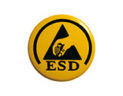
ESD shoes: what the yellow ESD marking means
The body becomes electrostatically charged while walking and working. A discharge only becomes noticeable from around 3,000 volts – sensitive electronic components can be damaged at far lower voltages without anyone noticing. ESD shoes (ESD stands for electrostatic discharge) dissipate this charge in a controlled way through the sole into a dissipative floor.
Conductive, antistatic, insulating, ESD
How a safety shoe behaves electrically depends on its electrical resistance:
| Marking | Electrical resistance | Purpose |
|---|---|---|
| C conductive | 102 to 105 ohms | Dissipate charge as quickly as possible – only where the risk of electric shock is completely ruled out |
| A antistatic | above 105 up to 109 ohms | Reduce and dissipate charge where electric shock cannot be completely ruled out |
| I electrically insulating | – | Where there is a risk of electric shock, for example from damaged live equipment |
| ESD | Person/footwear system below 108 ohms (100 megohms) | Protection of electronic components to EN 61340-5-1 |
The frequently quoted limit of 35 megohms was recommended by EN 61340-5-1 before its revision in 2017; some manufacturers still meet it with their ESD footwear.
Antistatic is not the same as ESD. The resistance range for "A" is considerably wider. Anyone manufacturing or handling electronic components needs explicit ESD suitability to EN 61340-5-1 – the "A" marking alone is not sufficient. ESD is not a protection class of its own but comes on top of one: a shoe can be marked S1 ESD, S1P ESD or S3 ESD, for example.
Do electricians need ESD shoes?
ESD shoes protect the components, not the wearer from electric shock. Whether electrically insulating footwear (I) is needed for work on electrical installations is determined by the risk assessment – an ESD shoe is no substitute.
Browse ESD safety shoes in our shop · see also ESD workwear and antistatic ESD gloves
Which safety shoe is right for me?
The legally required risk assessment cannot be substituted – but we can offer some rough guidance. The class follows from a few questions:
| Question | If yes |
|---|---|
| Are wet conditions to be expected? | at least S2 (S1 and S1P only for dry areas) |
| Can pointed objects penetrate the sole? | Penetration resistance: S1P, S3, S5 or S7 (P, PL or PS) |
| Does the complete shoe have to be waterproof? | S6 or S7 – or an S4/S5 boot |
| Permanently wet and dirty, rubber or polymer boot wanted? | S4 or S5 |
| Work on sensitive electronics? | ESD in addition |
- S1 suits work areas where no exposure to moisture is expected, primarily indoors.
- S1P, S1PL and S1PS cover the S1 range and add a penetration-resistant sole, reducing the risk from sharp and pointed objects such as screws or broken glass. For very fine objects, the PS variant is the stricter test.
- S2 is used where, in addition to the protection offered by S1, wet conditions are expected.
- S3 is the classic choice for foot protection, for example in construction: protection against mechanical impact, against moisture, and with a penetration-resistant insert.
- S4 and S5 are fully moulded rubber or polymer boots for permanently wet and dirty environments – agriculture, food processing or civil engineering, for instance.
- S6 and S7 are the right choice when the complete shoe has to be waterproof without being a boot: S6 based on S2, S7 based on S3. Typical for outdoor trades in sustained rain, roofers or winter road maintenance.
- ESD comes in addition where electronic components are manufactured or handled – together with the protection class the other hazards require.
Drawing on years of accident data from industry and trade, the DGUV has published a collection of examples that provides orientation when selecting foot protection – it does not replace the legally required risk assessment.
Safety footwear from inba arbeitsschutz
Our range covers safety and occupational footwear for women and men – from the safety shoe with a toe cap to the boot. You will find the footwear sorted by protection class, as ESD safety shoes and in large sizes.
Not sure which class suits your working environment? Give us a call or send us a message – we have been advising businesses in trade, industry, healthcare and hospitality for more than 30 years.
Last updated: October 2026. All information provided without warranty as to completeness or accuracy; the applicable official standard text is authoritative.